Archive for August, 2005

VJ Day Special Reporting – St. Pete Times

August 25th, 2005 by xformed

This coming Sunday’s (8/28/05) St Petersburg Times paper will have a special section with the interviews they did with the WWII veterans in the area for a tribute to VJ Day.

Last spring, the Times put out a call for veterans to share their story. From what I understand, about 100 people
responded. One of them was Jim Helinger, Sr, the glider pilot who’s story I have
posted. I was able to sit with Jim when the summer intern reporter videoed the interview for the paper. I’m looking forward to reading the memories of those who answered the call and stood up for us so many years ago. I don’t recall the reporter’s name, but I do know he was sent on many of the interviews. He is on vacation now, and will be coming back to work full time for the St Pete Times.

It struck me the day I sat with Jim and the reporter and as I heard the reporter discuss a few of the men’s stories he had received for this section, I couldn’t help but think what a wonderful gift of living history this young man received by sitting with these 80 some year old men and listening to how it was. I’m sure he will use those stories for many years, long after some of these veteran’s have left us.

Anyhow, I plan to get a hold of a few copies for my own files. If you’re set on getting your own copy, I’d be happy to try to get them to anyone who want’s them. The paper is $1 for the Sunday edition and then what ever the cost of an envelope that will keep the special section intact and postage. See my profile for the email address, or leave a comment here so I can get back to you.

Update 8/26: I found out this special section will also include the interview with Ben Garrison, one of the crew members of the USS MASON (DE-529), the only large ship crewed by African Americans in WWII.

Category: Air Force, Army, Humor, Military, Military History, Navy | Comments Off on VJ Day Special Reporting – St. Pete Times

The Adventures of Jim, Sr – Part III

August 15th, 2005 by xformed

I have posted two parts of this story previously. It is the story of the a glider pilot that I had the opportunity to meet in person and hear this story myself. Read all of it to get a picture of the life style of those who hauled troops and freight to the front lines. He flew 41 combat glider missions, but the best part of the story is how he celebrated VJ day in Paris.

Part I of the Adventures of Jim, Sr

Part II of the Adventures of Jim, Sr

Jim tells a story of a wartime romance that began in Paris, before the war had ended. Jim’s unit was stationed at St Andre, about 60 miles west of Paris. One day, Jim and his co-pilot, Eddie, were sitting at the Café de la Plait in Paris, having an aperitif when a young French woman, wearing a white angora sweater walked by. Jim said to his friend “I bet I can get her to have a drink.” In typical aviator fashion, his co-pilot spurred him on with a “Go for it!” response. Jim took off down the sidewalk and caught up with Denise Bellicord and asked if she would have a drink with him in, as he described it, very bad French. She looked at him and said “I speak English.” He said “I bet him an aperitif that I could get you to have a drink with us.” Denise asked: “Is this your first time in Paris?” “Yes” was Jim’s response. “You don’t just try to pick up a girl.” “I wasn’t trying to pick you up.” She went back and had a drink with Jim and his co-pilot, and that began the romance for the next year. Jim met the parents, and spent their free time together. Later Jim moved east, as the war progressed into Germany. Jim left Denise and did not see her again until after the war. She thought Jim had been killed, because she never heard from him after he left to go east.

The war in Europe ended, but with the war against Japan still being underway, and planning for the invasion of the Japanese Homeland in the work, there was still some uncertainty as to what would be the lot of the servicemen in Europe. While waiting for a decision on whether would be shipped to the Pacific Theater, the glider pilots would fly the C-47s. Jim saw an opportunity in the process of downsizing the troops in Europe.

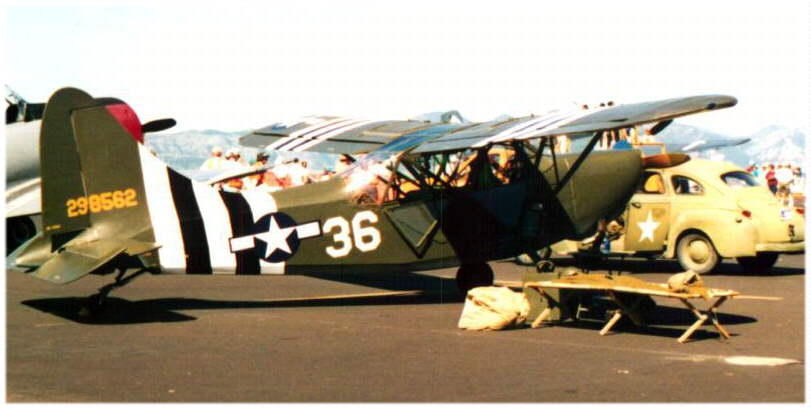
The Signal Corps were the ones who had flown the light spotter planes over the front lines. When the war ended, the Signal Corps troops were sent back to the states. They left their Stinson L-5 spotter planes behind in Europe to be burned. Jim and his fellow glider pilots, who were stuck overseas for the moment, had a better idea.

The glider pilots went to the aircraft mechanics at the base, who had been assigned to dispose of the spotter planes, Jim and his men went to the mechanics and asked that they hold one L-5 for each of the glider pilots. There were spotter planes pulled from the pile, on the promise that in return for maintaining the planes, the pilots would teach them how to fly after work. It was a great deal all around. Each pilot had his own plane, complete with his name painted on it, to fly as they wished. Jim used this to his advantage. More on this later.

On August 15th, 1945, Jim and his unit were still stationed at St. Andre, in France. On this day, the war with Japan ended. In order to celebrate this momentous occasion, Jim hopped in his “personal” aircraft and headed into Paris. The glider pilots had been using Renault Field as their local airfield, since the Renault Factory was not in operation, building aircraft. Arriving in Paris, he met Denise at a Paris café. Jim got a case of champagne, and they began drinking to celebrate. Then they decided to go to into the center of Paris, but the traffic was so bad, and the people so numerous, they couldn’t get to the Champs de Elise. Jim had a better idea. They could view the massive celebration from the air, in the comfort of his Stinson O-5 spotter plane, that had been tied down to a tree in at Renault field. They got in the plane (recall some champagne had already been consumed) and took off, heading to downtown Paris, he in the back seat, she in the front.

Off they went, crossing over the Seine River. Jim’s trained eyes picked out a bridge, and being the valiant aviator he was, he proceeded to fly under it. He saw more bridges around Paris, and proceeded to fly over and under about 20 of them, then he had a better idea.

Jim flew around the Eiffel Tower and scanned for obstacles and guy wires near or attached to the Tower. He saw none. Checking the Sun’s angle, he repositioned his plane. Jim did something that then put he and Denise Bellicord into the history books. He then flew under the Eiffel Tower, and quickly away into the sun. The next day, there was an article in the 15 August Paris Edition of the London Herald-Tribune, page one covered VJ Day, and on page two, there was an article saying a crazy American pilot had flown under the Tower, but could not be identified. Witnesses reported there had been two people in the plane celebrating the moment.

After the war completely ended, Jim volunteered to stay in Europe. He was assigned as the Special Services Officer for the Munich Base. He was the man responsible to make sure there was something the keep the morale of the troops up. He was also responsible for two rehabilitation hotels, as well. He had his own jeep and….his own plane. While at Munich, Jim felt he had to see his French girlfriend, Denise one last time. Jim approached the Base Commander, a colonel, and the conversation went something like this:

Jim: “Colonel, we have a problem.”
Col: “What’s that?”
Jim: “You know the movie theater? The lens in the projector is cracked.”
Col: “Can we fix it?”
Jim: “No, we have a spare, but it’s the only one.”
Col: “Requisition one.”
Jim: “It will take 6 weeks. I have some contacts in places you’re not exposed to that can help us sooner.”
Col: “Ok, what do you need?”
Jim: “A plane.”
Col: “Ok, I’ll get you a C-47.”
Jim: “I’ll pick the crew.”
Col: “There’s something else?”
Jim: “We might want to see our old girlfriends one last time. You want us to be happy, right?”
Col: “Yes.”
Jim: “We’ll need to RON (remain overnight).”

The rest of the story is Jim took a co-pilot, flight engineer, a crew chief and a navigator. The RON ended up being three nights and 4 days. They did happen to see their old girlfriends, and yes, Jim did see Denise. A new projector bulb was not “procured” from the black market in Paris, as it seems the first bulb wasn’t cracked in the first place.

At the end of the war, the Rockettes Show in New York was purchased and put on contract to the Army to provide entertainment for the troops who had remained behind in Europe. Jim said the contract for the show required the military to return the show members to the states in the same condition as they went over. Jim, as the Special Services Officer, was responsible for setting up the shows for Munich. With that, and his interaction with the cast and crew, one of the women in the cast, Veronica Bridgette Nolan, caught Jim’s eye. Jim met here and they began dating. Since the show was traveling around Europe, Jim needed some way to get around to see his new girlfriend.

This is where his “personal” aircraft came in handy. He was able to just go pretty much as he pleased, particularly since the need for the actual flying of gliders had ended when the Germans had surrendered. Occupation duties went on, and he continued to follow his American fiancée around the circuit of the Rockette’s show in his “private” plane.

Jim and Veronica courted, got engaged, then got married in the Catholic Church in Haar, Germany. She wore a nylon wedding dress, made from Jim’s parachute by a local seamstress. They returned to the States, settling first in New York City.

In 1949, as Jim drove to work at Macy’s, he was listening to the Tex McCrary and Jinx Falkenburg radio program. That day, they were interviewing the only actress in the movie “Battleground” that had appeared in the list of the stars in the film. She had a French accent, as she promoted the movie over the airwaves. Her name was Denise Darcel. As soon as Jim got into work, he called the radio station and asked to speak to Tex McCrary. He was routed to a secretary, who asked what the call was about. He said he’d like to talked to Tex privately about his guest. She told him they get a lot of calls and she would take his number and if Tex wanted to call, he’d hear from him. Jim asked if the secretary would tell Tex he had know his guest years ago as Denise Bellicord. He hung up the phone and went to work. A few hours later, Jim got a call, having put the earlier call out of his mind. It was Tex, saying because he had supplied Denise’s family name, which she had told them in the studio, and therefore no one else would have know it, he wanted to hear how Jim and Denise’s story had ended. Jim honestly answered “It didn’t.” He told Tex how he had been transferred to Germany. Tex told Jim he would pass the story on to Denise, and leave it up to her if she would like to see him.

About 4PM, Jim’s phone rang. It was Denise. He apologized and she asked when she could see him. He said he couldn’t, as he was now married and had two children. Denise said: “I must see you.” “When?” “The matinee show tomorrow.”

Jim arrived at the stage door of the show with a dozen red roses. The stage crew ushered him in and put him in a center front row seat. When Denise came on stage to sing, she began with “You, Jimmy! I think he kaput in the war, you bad boy!” From there, she proceeded to tell the story of the two of them flying under the bridges, and the Eiffel Tower on VJ Day, August 15th, 1945.

Jim and Veronica divorced and the Herald-Tribune paper of August 16th, 1945, attesting to Jim’s daredevil flight was lost in the split. Many years later, Jim and his second wife, Jane, traveled to Paris, and stopped in the London Herald-Tribune Office. Jim asked to see the publisher. Upon completing the introductions, the publisher told Jim he had heard the story, and they had a reporter who had been on staff in Aug, 1945. They met the old reporter and he confirmed Jim’s story. The reporter told Jim that he was the first of 6 people to fly under the Eiffel Tower to date. Unfortunately, they told Jim the archives were across town and couldn’t be accessed in time to get a copy of the paper for him.

No story is complete, when you are speaking of an aviator of almost any kind without finding out what their “call sign” or peer given nick name. Jim’s call sign was “Bung.” The moniker relates to the name of the wooden plug that is put in the side of large beer kegs. It is placed there after the keg is filled, using a mallet to seat it. It is also the thing that is removed to place the tap and empty the keg.

Jim says his favorite song during the war was “Moonlight Serenade” by Glenn Miller.

On his birthday, Jim occasionally goes to a local airfield and takes a flight in a small plane. He is unable to fly himself anymore due to health issues, but he flies with a certified instructor and gets in a little supervised “stick time” in remembrance of his service time.

Jim joined the service on his 18th birthday and served with “The Greatest Generation.” He returned to the States and has since become a father, and a successful businessman, and part of the economic engine of America. Today Jim Helinger, Sr. lives in St. Pete Beach, Florida, and runs his own business. He is also the Florida State WWII Combat Glider Pilots Association Commander and regularly gives speeches to interested civic and church groups on the eight major combat glider operations of WWII.

Category: Air Force, Army, History, Military, Military History | Comments Off on The Adventures of Jim, Sr – Part III

How to Bury a Hero by HM3 James Pell, USN

August 14th, 2005 by xformed

I’ve not been posting too much the last few days, for I was “teaching history” to those who want to equate the “WHERE are the WMDs?!?!?!?” discussion to the moral equivalent of “hate” crimes against the transgendered. It really wore me out. I was a little discouraged, realizing the emotional toll that occurred trying to have an actual discussion with a bunch of animated Democratic talking points.

In a few moments of surfing this afternoon, I found the following comments just a few minutes ago. I was chasing links to read about a young Marine, LCpl Antoine Smith. He was killed by hostile fire at Fallujah. I chased the links to Pull on Superman’s Cape and under this post, titled The Heros of India Company, I found the words of a junior enlisted Navy Corpsman who had been at the side of LCpl Smith when he was
killed. He recalled that moment like this:

“Forgive my spelling. I was next to Lcpl Smith as he took his last breath. As a US Navy Corpsman I am there to help trasition heroes into the next life. I was flipping through the TV Sunday night and came across “Heroes of India Company”. I wasn’t aware that this documentary existed. I paused and watched as I relived the fight. I was with 3/5 untill I was shot Nov 15, 2004. I am the Sniper platoon Cormpsman. After Smith went down and the bombs were dropped we pushed on. We engaged in a fierce fight with five insurgents across the street. It was roof top to roof top. Then out of no were the house next to us opened up and pinned us down. My Sniper partner and myself stormed the third story roof killing two insurgents. Once ontop of the third story the Marines started moving across to the second deck. First over was Shane. No sooner had he crossed over the wall I heard him scream for help.

I looked over the edge and saw him holding his head, still screaming. I did what any true Marine loving Corpsman would do, I went after him to pull him out of the line of fire and treat his wound. I never made it to Shane though. I hung my feet over the third deck to jump to the second were Shane was no lying motionless. As I started to slide off It felt like a sledge hammer smashed into my right thigh, and it went limp. No sooner the same feeling in my right calf. It hit me, I’m being shot! I looked for a way to get out of the insurgents path and chose to jump off the side of the building. Before I could make the move My left leg went limp as more AK-47 rounds went through the upper thigh, calf and foot. As I was falling the insurgents rounds found target again, two round to the lower right abdomin and two round to the upper groin. I fell two stories and dislocated my right shoulder. Because of the medical training I gave my Snipers every day, Lcpl James Powers saved my life. He prompty stopped the massive bleeding from my legs. From the beginning to the end I was with both Smith and Shane. Everything medicaly possiable was done to preserve life. I am now training others that are heading to combat, awaiting my Marine Corps family to return from Fallujah this month.

EMCEE: James, I cannot express in words just how much brave Marines like you mean to me. Everything I can think of just fails to say to you what I feel. Let me just say: Thank you. Thank you from the bottom of my heart. On behalf of the American people I thank you. On behalf of the brave men and women that you serve I thank you. Your courage and valor inspire me. I thank God for patriots like you sir. God Bless You!

Posted by: HM3 Pell, James at March 1, 2005 09:36 AM”

That was powerful to read the after action report of a comrade in arms.

A few comments down, here was something that speaks with even great power about the bond that combat forges between warriors by the same young man. This was not said by a Marine General, or a Pentagon Press Briefer, but by one who has been “there:”

“How to bury a hero.
Andrew Keeler was one of the best SS [Scout Sniper] I ever knew. He was dedicated to his country and his brother in arms. He died outside of of the capital in early April. Killed while participating in convoy operations. We, his military brothers, flew to the funeral to be the his honor guard. Once at the cemetary the uligy was read and flowers placed on the casket. The five of us wated until all the public had left the site and we, the people that knew more about Andrew than his own family, opened his casket and pinned on the medals he earned in combat. We closed the casket and together lowered it into the ground. Before we landed for the funeral we all agreed that no minumum wage cemtary worker was going to touch this heros coffin, or the dirt that was to cover it. So the five of us picked up our shovels and burried Andrew shovel by shovel. We tamped the dirt and relaid the sod, then stood over the sight silently for a few minutes to honor Andrews life. Then we got smashed on the plane ride home. This is how I wanna go when the time comes…

Posted by: HM3 Pell James at April 12, 2005 01:59 PM’

As HM3 James Pell is now forever a part of the brotherhood of the USMC, despite his beginnings at a Navy Boot Camp, I’m sure his brethern will honor his wishes.

I hope you find it in you to pass these words along to those who haven’t yet comprehended what the real meaning of friendship is. Please make sure the credit to Hospital Corpsman Third Class James Pell, USN of the Fleet Marine Force, is always included with this quote.

To reconnect with my opening remarks, while the subject matter above is sad, knowing these young men have passed from our presense, I am overjoyed to see that there are those in the younger generation who truly “get it.” More amazing still that HM3 Pell shows wisdom beyond his years. I’m hopeful for the future of the US and the western world as a result.

Email HM3 James Pell here

Category: History, Marines, Military | 1 Comment »

“Inspectmanship” vs. “Getting It”

August 8th, 2005 by xformed

I had the occasion to work with a recent high school grad a few weeks back. We got to talking about having to rewire a specialized convection heater in the business after a problem, and I mentioned I just went back to my basic electricity education from junior high school shop (I guess we call that “middle school” now) to realize one of the wire grounded out one of the two heating coils. I just sat down and diagrammed the wiring, and traced it around functionally, only to find out when I had replaced the wires, I caused the problem myself.

He said “They don’t teach that.” That initiated a conversation about “shop.” He told me when he took shop, it was taught by a teacher who had a different main subject assignment, and he didn’t even care if the kids showed up in class, since it was just an add on to his normal teaching. Freddy amplified this to say “they only teach us what we have to know for the FCATs.” FCAT stands for “Florida Comprehensive Academic Test.” FCATs have grown out of the “No Child Left Behind” initiative of George Bush’s presidency. The very concept is a powerful one, but it’s how the states reacted to this is interesting. I see parallels in how the attitude presented above may have come about. If performance of the students allows access to Federal funding, then the outcome of the testing cane take on a life of it’s own, leaving basic learning in the ditch of the academic process. That’s what I will attempt to analyze below.

Freddy’s one line about FCATs stood out, and for the past week, kept cropping back up in things I read, heard or recalled of my past experiences. A few Saturday back, I was scanning the letters to the editor in the St Petersburg Times and came across a letter from a mother indicating she was considering pulling her children out of public schools, because all they were being taught was what they needed to pass the FCATs. Two “hits” in my scan of life in a week’s time. It took me back to thinking about all my years in the Navy, where inspections are a way of life, and most particularly, three years being assigned as the lead inspector for the surface ships in combat systems readiness.

“Gouge” was a valued commodity in schools and around the waterfront. A regularly heard statement was: “If the minimum wasn’t good enough, it wouldn’t be the minimum.” Plans of Action and Milestones (POA&Ms) for various readiness exams and training work were passed between ships. You found time to walk the piers and meet your counterparts on other ships, in order to “get the gouge.” The rumors went around and it was common knowledge which ships did well and which tubed the inspections. Hint: Don’t use their “gouge.”

The culture was easily lulled into doing enough to get by sometimes, with the focus being that one and only inspection, the wolf closest to the sled. When times were hectic with deployment and training schedules, it seemed the next avalanche of work for the next big event kept coming. Sometimes the best you could do was to figure out the path of least resistance to the passing grade. Striving for excellence was an entirely different ball game.

The FCAT issue reminds me very much of the situations I saw in the Fleet. My department had scrubbed check sheets for the areas in Combat Systems to be inspected to make sure we could tie a written requirement to every single thing we checked on. We listed the references and the mailed out copies of the check sheets to every ship. In other words, they had the complete list of things to be passed in their hands. The corollary to this is knowing the FCATs are coming and having knowledge of what areas they will test. No surprises here.

Next comes: What will be your view of how to approach the “inspection?” You do have to get through it, so the “matrix” is satisfied for the paper pushers at higher headquarters. I saw two basic attitudes on the ships regarding receiving inspections:

1) Get the list, do all of these things. Make sure these things are ready/done right. Anything else is merely wasted effort and;
2) This inspection is a stepping stone to the future success of the ship, and here are many things we need to understand and make sure they are done.

The difference is the focus on what to do, versus knowing your job, with the check points being an essential part of that knowledge.

I think the educators here in the local area, based on Freddy’s comments regarding teachers who could care less about teaching shop and the letter to the editor claiming teaching is specifically targeted at only FCAT knowledge requirements, have adopted attitude #1. I’d recommend they try approach #2. Here’s my argument:

Situation #1 discounts “peripheral learning” as wasted energy. Since there is a list of what to know, go for that, and that alone. Peripheral learning is where you learn things that will compliment your understanding of the main topics of concern, as well as just adding knowledge for later essential use. The ships I saw that took this approach, which actually was the majority, were the very ones who were inflexible in their thinking on most all other areas, which generally, at the least, kept their grades down, and at the worst, failed them. Life, and combat, are full of the need to be flexible, and practicing rigidity is counter productive to success. In attempting to attain the highest grades possible, it actually appeared they were their own worst enemy. I see the schools doing the same thing, based on my understanding that our schools are to develop young minds to come out and do excellent things in the economy.

Approach #1 is the short sighted view. It is a selfish attitude in that it becomes an exercise in maintaining educational funding, which translates into job security for the administrators and teachers. Yes, some of the funding will go to school programs and equipment, which will be used by the children, but how does that do the children any good if they are unequipped for entering the workforce? I will admit I haven’t used calculus in detail since I took it, but the understanding of this form of math has helped me make sense out of some things I’ve dealt with.

Approach #2 demonstrates an understanding that all the preparation/study effort is to clear a hurdle, enabling you to grow to new levels of knowledge, and that the inspection criteria are representative of the areas of study, but not the only things to know. It’s the maturity of the professional attitude. In the case of the educators, it would be to understand the skill sets tested in the FCAT are essential elements of knowledge, but no guarantee that the exact question will face each of the students later in life. It also demonstrates an understanding that the real success of the students will be shown in later years, when they are in the economy, fully participating for the betterment of the society as a whole, while being able to care for themselves. I submit to take this method to heart will achieve the very goals of showing improvement in the FCAT scores. It facilitates learning, and better yet, understanding.

Here is my supporting “sea story:”

I met a prospective Commanding Officer (PCO) in one of the offices on the CINCLANTFLT compound. He was then a Commander and the prospective commanding officer of a OLIVER HAZARD PERRY Class Guided Missile Frigate (FFG) . My Officer in Charge and I had just dropped the final draft of the revised Combat Systems Assessment (CSA) procedures off with the COMNAVSURFLANT Chief of Staff for signature by Admiral Reason. I had a copy of the final draft in my brief case. As my OIC was giving this PCO and another one their briefing as to the services our training unit provided, he mentioned the CSA was just revised and would be “all new” and designed to test the ship’s ability to retain it’s performance via use of an on board training team of the ship’s company. The CSA would evaluate the our confidence in the ship to carry out and critique training effectively, and that would determine passing or failure of the CSA. I quietly reminded the OIC I had a copy of the new instruction with me. He told them we would give them the final draft to get familiar with. I went and found a Xerox machine and made two copies. When my OIC was done, I spoke with the PCO and told him I welcomed riders on our inspections, so they could see how we worked, but more importantly, to get a good idea of how to handle the mass of information on the check sheets.

The FFG for this PCO was homeported in Newport, RI. One “O-Dark-Thirty” morning on a tug boat in Charleston Harbor, my team and I were heading out to one of the Charleston based ships, that had been out at sea the day before, practicing their teams. In Charleston, this was a standard practice for DESRON SIX ships, and we got a nice ride to the sea bouy as the sun rose. As I drank my coffee in the pre-dawn twilight, I noticed a chief petty officer nearby. I assumed he was ship’s company, who was headed back to the ship. I asked what his division on the destroyer. He told me he wasn’t assigned to the ship, but had come from the the FFG, because his CO said we were welcome come along. I grinned. He told me the “new” CO had said that before they had their CSA, he would have every man wearing khaki (officers and chief petty officers) ride along on one of our CSAs as observers. That’s what happened. An attentive rider from the FFG became our companions on subsequent CSA the length of the east coast.

The procedures back then were to conduct a “basic” CSA (CSA-B), where we ran all the check sheets, but would assist the crews as needed. We graded things as close to as we found them during those 36 hours, so the ship might see where it stood. The results were between us and their squadron, but were not provided to the type commander. A few weeks later, we would return and redo the CSA, but this time, it was for the grade to be reported up the chain of command. This was the “advanced” CSA (CSA-A).

The FFG had briefings by the returning crew that had watched over our shoulders. The worked on their check sheets, and gamed out ways to do the work better, and to make sure all who needed to understand the material were trained and “plugged in.” I remember getting calls from the Combat Systems Officer of the FFG, asking if they could use some testing equipment from the SONAR system to generate a target track for the operational drills. I discussed this with my system experts, many of whom had been instructors at the school for that piece of equipment, and they had never thought of doing it that way, but agreed that would be a little manpower intensive, but provide very realistic training for the operators. That illuminated the attitude of the crew of the FFG

One time, we had scheduled a CSA out of Newport, RI. A few days before we flew up, now CO called me and said “I understand you aren’t flying out until the next afternoon following the CSA. I wondered if your and your team might have some time to come aboard and sit down with my crew that morning?” He had had his crew thinking ahead of the game, looking for opportunities to get more instruction and training and they had researched our schedule to find out when they could see us. That morning, we arrived aboard and the leadership was ready to talk business. They had cleared the schedule for our impromptu visit. My men, as usual, rolled up their sleeves and went to work. The FFG crew picked their brains, asking questions that certainly indicated they had read the references well, and then some more material. They had the focus of preparing the ship and crew for deployment, not just how to get the best grade for this one inspection.

A few months later, it was time for the FFG CSA-B. As we walked down the pier, I saw CO at the foot of the brow. As I approached, he called me aside and asked that I ask my team to not interfere with his crew, unless a safety issue arose, going through the CSA (this was the basic, and interaction was routine), so they could tell where they stood. He thought they were ready, but he wanted an assessment of his crew alone. I passed this to my men. The result was they scored as high as most ships were on their CSA-A. Not one time did my men have to step in for anything the entire 36 hours. Yes, there were flaws, but then they got right on them.

A few weeks later, the CSA-A was held. The crew was unflappable, the execution almost flawless, the ship clean, and the equipment was in working order. Record keeping, across the areas of maintenance, training, certification were all in order, and it was obvious it had not been “constructed” the few days before from scratch. The CO allowed his chain of command to make decisions at their level, and he watched, but never interrupted so long as they were making good decisions. The one time the Tactical Action Officer made a less than optimum choice, he waited until there was a lull in the action, took him aside, corrected him, then sent him back to keep going. The 189 man crew of a guided missile frigate scored the highest grade to date. Until I left my inspector job, about a year after this had happened, the FFG retained the highest score for Combat Systems Assessment for the Atlantic Fleet surface ships. I believe they may have even held that record until the CSAs were dropped, two years later.

I heard they passed their Operational Propulsion Plant Exam (OPPE) with similar outstanding results. Later, during weekly briefings for COMNAVSURFLANT, it wasn’t unusual for briefer in some area to mention some outstanding report of the FFG performance while deployed to the Mediterranean with COMSIXTHFLT. Reports like this were uncommon, so there had to be something special going on aboard the FFG.

There were many ships that tried to preemptively up their score by “smoozing” my team. I do recall sitting down for the inbrief at the wardroom table and a can of cold Coke and a bag of peanut M&Ms was next to the folder with my name on it. They had called the ships before them and asked “what did I like.” They did OK, but I would have preferred they would have called to ask how to make sure their crew training was done well, so they would be ready to show my team how proficient they were.

This CO of the FFG not only “got it,” he communicated it clearly to his crew. If he was in charge of FCATs, I think the Florida children would be pretty close to the top of the nation in scores, but not because he would have educators focus on getting a good score each year, but to ready the children to perform on a “forward deployment” in the real world after school, as productive members of the economy. He didn’t settle for an individual good scores, he only settled for success in the end game.

Category: History, Political | Comments Off on “Inspectmanship” vs. “Getting It”

Copyright © 2016 - 2026 Chaotic Synaptic Activity. All Rights Reserved. Created by Blog Copyright.

Switch to our mobile site